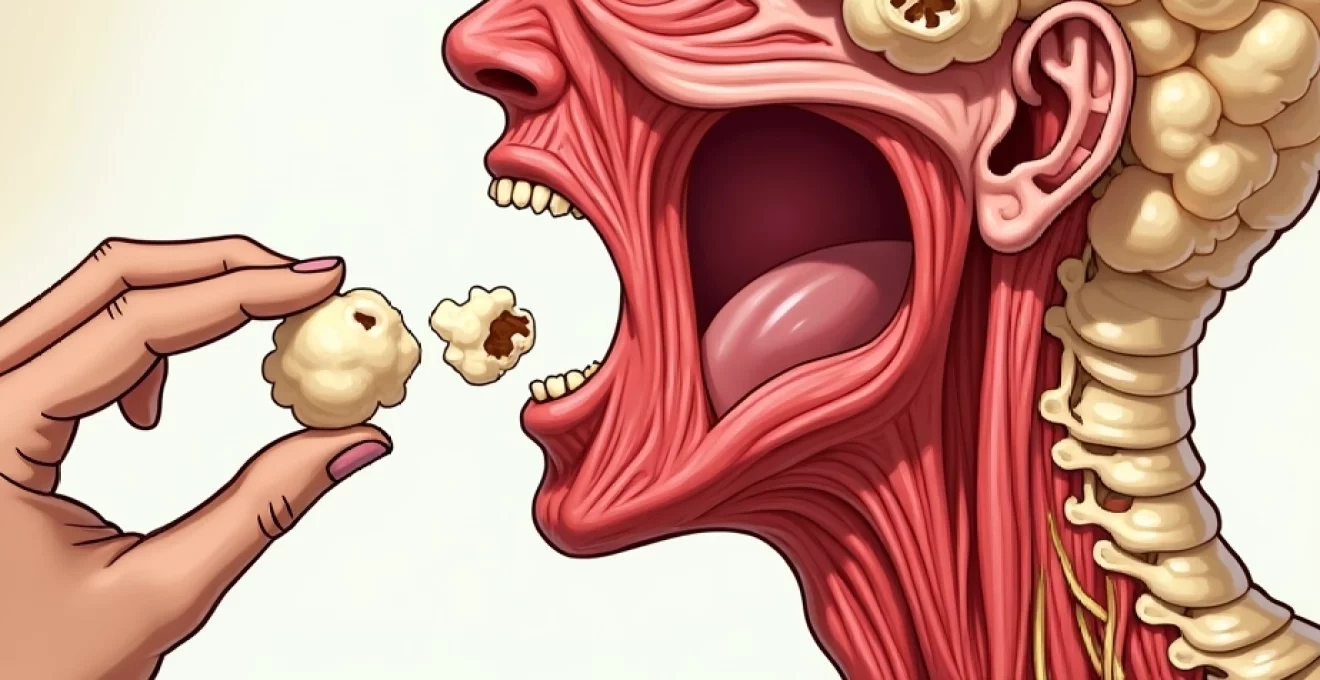
Having a popcorn kernel or hull lodged in your throat ranks amongst the most frustrating food-related mishaps that can occur during what should be an enjoyable snacking experience. This seemingly minor incident can quickly escalate from mild discomfort to genuine concern, particularly when traditional swallowing attempts prove ineffective. The sharp, irregular surfaces of popcorn hulls possess an unfortunate tendency to embed themselves within the complex anatomy of the throat, creating sensations ranging from persistent irritation to more serious obstruction symptoms.
Understanding the appropriate response protocols becomes crucial when faced with this common yet potentially problematic situation. The human throat’s intricate structure, combined with popcorn’s unique physical properties, creates specific challenges that require targeted intervention techniques. Whether you’re experiencing minor irritation from a small hull fragment or dealing with more substantial obstruction, knowing how to respond appropriately can prevent complications and provide swift relief.
Medical professionals encounter popcorn-related throat obstructions regularly, making this issue far more prevalent than many people realise. The combination of popcorn’s popularity as a snack food and its inherent structural characteristics means that millions of individuals worldwide face similar experiences annually. Recognising when a situation requires immediate intervention versus conservative self-treatment can make the difference between quick resolution and prolonged discomfort.
Immediate emergency response protocols for popcorn obstruction
Recognising the severity of a popcorn obstruction situation demands immediate assessment of your breathing capacity and overall comfort level. True choking emergencies, characterised by complete or near-complete airway blockage, require swift intervention using established emergency protocols. However, distinguishing between genuine choking and the more common experience of throat irritation from lodged hull fragments becomes essential for determining the appropriate response level.
Heimlich manoeuvre application technique for kernel dislodgement
The Heimlich manoeuvre should only be employed when genuine choking occurs, indicated by inability to speak, breathe, or cough effectively. This life-saving technique involves positioning yourself behind the affected individual, placing your hands just above their navel, and delivering firm upward thrusts to create artificial coughing pressure. The sudden increase in abdominal pressure forces air upward through the respiratory tract, potentially dislodging the obstructing material.
Proper hand placement proves critical for effectiveness and safety. Form a fist with one hand, positioning the thumb side against the victim’s abdomen between the navel and ribcage. Grasp this fist with your other hand and deliver quick, upward thrusts with sufficient force to compress the diaphragm. Each thrust should be distinct and forceful enough to create measurable chest movement whilst avoiding excessive force that might cause internal injury.
Modified abdominal thrust method for Self-Administration
When experiencing genuine choking whilst alone, self-administered abdominal thrusts become necessary for survival. Position your fist against your upper abdomen, just below the ribcage, and thrust upward and inward with decisive force. Alternatively, lean over a solid surface such as a chair back or table edge, positioning the edge against your upper abdomen and pressing downward forcefully to create the same compressive effect.
The effectiveness of self-administered techniques relies heavily on proper positioning and sufficient force application. Many individuals underestimate the pressure required for successful dislodgement, leading to ineffective attempts. Practice proper technique during non-emergency situations to develop muscle memory and confidence in execution when genuine emergencies arise.
Back blow positioning and force distribution mechanics
Back blows serve as an alternative emergency technique, particularly effective for certain types of upper airway obstructions. Position the choking individual leaning forward at approximately a 45-degree angle, supporting their chest with one hand whilst delivering five sharp blows between the shoulder blades using the heel of your other hand. The forward-leaning position utilises gravity to assist in dislodging material toward the mouth rather than deeper into the airway.
Force distribution across the back requires precision targeting to maximise effectiveness whilst minimising injury risk. Direct blows toward the spine’s centre, avoiding the shoulder blade edges and lower back regions. Each blow should be delivered with sufficient force to jar the chest cavity whilst maintaining control to prevent excessive trauma to surrounding tissues.
Emergency service contact protocols and choking classification
Emergency services should be contacted immediately when initial intervention attempts prove unsuccessful or when the choking victim becomes unconscious. Provide clear, concise information regarding the obstruction type, victim’s current status, and interventions already attempted. This information enables emergency responders to prepare appropriate equipment and personnel for the most effective intervention upon arrival.
Understanding choking classification helps determine urgency levels and appropriate response measures. Complete airway obstruction, characterised by inability to make vocal sounds or breathe, requires immediate emergency intervention. Partial obstruction, allowing some air passage and vocal sounds, may permit more conservative approaches whilst maintaining readiness for escalated intervention if conditions deteriorate.
Anatomical understanding of popcorn hull lodgement in pharyngeal structures
The human throat’s complex anatomy creates numerous potential sites where popcorn hulls can become trapped, each presenting unique challenges for removal. Understanding these anatomical considerations helps explain why certain locations prove more problematic than others and why specific removal techniques work more effectively depending on the lodgement site. The irregular, sharp-edged nature of popcorn hulls allows them to catch on tissue surfaces and resist normal swallowing mechanisms.
Oropharyngeal cavity and tonsil crypts as common entrapment sites
Tonsil crypts represent particularly notorious locations for popcorn hull lodgement due to their irregular surface topography and natural tendency to trap debris. These small recesses within tonsillar tissue create ideal catching points for hull fragments, which can embed deeply and resist normal clearing mechanisms. The crypts’ narrow openings often allow hull entry but prevent easy extraction through conventional swallowing or coughing.
Oropharyngeal surfaces, including the soft palate and posterior tongue base, provide additional sites where hulls commonly lodge. The transition zones between these structures create natural catching points where irregular food particles can become temporarily or persistently trapped. Understanding these anatomical relationships helps explain why certain removal techniques prove more effective than others for different lodgement locations.
Epiglottic fold and laryngeal vestibule obstruction patterns
The epiglottis and surrounding laryngeal structures present particularly concerning lodgement sites due to their proximity to the vocal cords and lower airway. Hull fragments becoming trapped in these areas can create significant discomfort and, in rare cases, may interfere with normal vocal cord function or breathing patterns. The protective reflexes associated with these structures often intensify the sensation of obstruction even when actual blockage remains minimal.
Laryngeal vestibule anatomy creates natural catching points where popcorn hulls can lodge during the swallowing process. The complex muscular coordination required for normal swallowing can be disrupted by foreign material presence, leading to persistent sensation of obstruction even after the hull has moved to a less critical location. This phenomenon explains why throat discomfort may persist even when breathing remains unaffected.
Oesophageal sphincter response to foreign body presence
The upper oesophageal sphincter’s response to foreign body presence involves complex muscular coordination that can either facilitate or impede hull passage. Normal sphincter relaxation, essential for successful swallowing, may become disrupted by the presence of irregular material, leading to temporary retention at the oesophago-pharyngeal junction. This muscular response often creates the sensation of material being “stuck” even when the obstruction is temporary.
Sphincter spasm, a protective response to foreign material, can actually worsen hull retention by preventing normal passage into the oesophagus. Understanding this physiological response helps explain why forced swallowing attempts often prove counterproductive and why relaxation techniques may prove more beneficial than aggressive intervention attempts.
Vallecular and pyriform sinus hull accumulation mechanisms
The valleculae and pyriform sinuses represent anatomical recesses where popcorn hulls commonly accumulate during normal eating processes. These natural depressions, designed to channel food safely around the airway during swallowing, can inadvertently trap irregular food particles. Hull accumulation in these areas often creates persistent foreign body sensations without actual airway compromise.
Pyriform sinus anatomy particularly predisposes to hull retention due to its narrow drainage pathways and proximity to sensitive nerve endings. Material lodged in these areas triggers significant discomfort disproportionate to actual obstruction severity. The complex innervation of these regions explains why even small hull fragments can create substantial subjective symptoms requiring targeted intervention approaches.
Professional medical intervention techniques for persistent obstruction
When conservative self-treatment measures prove insufficient, professional medical intervention becomes necessary to safely remove persistent popcorn hull obstructions. Healthcare providers possess specialised equipment and expertise enabling them to visualise and remove foreign material that remains inaccessible through conventional methods. Understanding available professional techniques helps determine when to seek medical assistance and what to expect during professional intervention.
Laryngoscopic examination and direct visualisation methods
Direct laryngoscopy provides healthcare professionals with clear visualisation of the throat’s upper regions, enabling precise identification and removal of lodged hull fragments. This technique involves inserting a rigid laryngoscope to displace tissue and create clear sight lines to areas typically invisible during routine examination. The enhanced visualisation capability allows for targeted removal using appropriate instruments whilst minimising surrounding tissue trauma.
Indirect laryngoscopy, utilising mirrors or flexible scopes, offers alternative visualisation approaches for different clinical situations. The choice between direct and indirect methods depends on factors including hull location, patient comfort, and anticipated removal complexity. Professional assessment determines the most appropriate visualisation technique based on individual circumstances and anatomical considerations.
Flexible nasendoscopy for posterior pharyngeal assessment
Flexible nasendoscopy enables comprehensive examination of posterior pharyngeal regions often inaccessible through conventional examination methods. This minimally invasive technique allows healthcare providers to navigate complex anatomical pathways whilst maintaining patient comfort throughout the procedure. The flexible scope’s manoeuvrability permits detailed assessment of areas where hull fragments commonly lodge, including the nasopharynx and posterior laryngeal structures.
The procedure’s diagnostic capabilities extend beyond simple visualisation to include assessment of surrounding tissue irritation and inflammation resulting from hull presence. This comprehensive evaluation helps guide appropriate treatment approaches and determines whether additional interventions may be necessary beyond simple hull removal. Patient tolerance for nasendoscopy generally proves excellent, making it a preferred diagnostic approach for complex hull lodgement cases.
Magill forceps extraction under controlled conditions
Magill forceps represent the gold standard for professional foreign body removal from the upper respiratory tract. These specialised instruments feature angled tips designed specifically for navigating throat anatomy whilst maintaining precise control during extraction procedures. The forceps’ design enables healthcare providers to grasp and remove hull fragments whilst minimising trauma to surrounding tissues.
Extraction procedures using Magill forceps require careful technique and patient cooperation to ensure successful removal without complications. The controlled environment of professional medical settings provides optimal conditions for safe extraction, including appropriate lighting, suction capability, and emergency equipment availability should complications arise. Professional expertise in forceps manipulation ensures efficient removal whilst maintaining patient safety throughout the procedure.
Bronchoscopic retrieval for lower respiratory tract involvement
Bronchoscopic intervention becomes necessary when hull fragments migrate into the lower respiratory tract, a relatively uncommon but serious complication requiring immediate professional attention. This advanced procedure involves inserting a flexible bronchoscope through the vocal cords into the trachea and bronchi, enabling direct visualisation and removal of foreign material from these critical airways.
The complexity of bronchoscopic retrieval requires specialised training and equipment typically available only in hospital settings. The procedure often necessitates sedation or anaesthesia to ensure patient comfort and procedural success. Recovery following bronchoscopic hull removal usually proceeds smoothly, though patients require monitoring for potential complications such as pneumonia or respiratory irritation.
Conservative Self-Treatment methods for minor hull irritation
Most popcorn hull incidents involve minor irritation rather than genuine obstruction, making conservative self-treatment approaches both appropriate and effective. These methods focus on encouraging natural clearance mechanisms whilst providing symptomatic relief during the resolution process. Understanding when conservative approaches remain safe versus when escalated intervention becomes necessary helps prevent unnecessary anxiety whilst ensuring appropriate care when genuinely needed.
The key principle underlying effective conservative treatment involves facilitating natural clearance mechanisms rather than forcing removal through aggressive intervention. The throat’s natural protective reflexes, including coughing and swallowing coordination, often prove remarkably effective when given appropriate support and time to function. Patience combined with gentle encouragement of these natural processes frequently achieves better results than forceful intervention attempts.
Gentle, persistent application of conservative techniques often succeeds where aggressive approaches fail, highlighting the importance of allowing natural clearance mechanisms time to function effectively.
Hydration plays a fundamental role in successful hull clearance by maintaining optimal tissue moisture and facilitating smooth passage of trapped material. Room-temperature water proves most effective, as extreme temperatures may cause throat muscle spasm and actually impede clearance. Small, frequent sips work better than large volumes, allowing gradual softening and mobilisation of lodged hull fragments.
Swallowing techniques can be modified to maximise clearance effectiveness whilst minimising discomfort. Rather than single, forceful swallows, multiple gentle swallowing motions often prove more successful. The repeated muscular contractions gradually work to dislodge and move trapped material whilst avoiding the throat spasm that aggressive swallowing can trigger.
Throat clearing techniques require careful application to avoid vocal cord trauma whilst maintaining effectiveness for hull removal. Gentle, controlled coughing proves more beneficial than violent coughing spasms, which can actually drive hull fragments deeper into tissue crevices. The “huffing” technique , involving forceful exhalation without vocal cord contact, often achieves effective clearance whilst minimising tissue trauma.
Position changes can significantly impact clearance success by utilising gravity and altering anatomical relationships within the throat. Tilting the head in various directions whilst swallowing may help dislodge hull fragments from specific locations. Some individuals find that lying down or standing up changes the effectiveness of clearance attempts, suggesting that gravitational effects play important roles in hull mobilisation.
Soft food consumption can assist hull clearance by providing gentle mechanical action to help dislodge trapped fragments. Foods such as bread, bananas, or cooked rice create sufficient bulk to encourage hull movement whilst remaining soft enough to avoid additional trauma. The mechanical action of chewing and swallowing these foods often succeeds where liquid-based approaches prove insufficient.
Honey and warm liquids combine antimicrobial properties with soothing effects to reduce irritation whilst encouraging hull clearance. Honey’s thick consistency helps coat and protect irritated tissues whilst its natural antibacterial properties may prevent secondary infection in areas where hull fragments have caused minor tissue damage. Warm liquids promote muscle relaxation and may help soften hull fragments, facilitating their eventual passage.
Preventative strategies and popcorn consumption safety protocols
Preventing popcorn hull lodgement proves far more effective than treating the problem after it occurs, making awareness of risk factors and preventative techniques essential for safe popcorn enjoyment. Understanding the relationship between eating habits, popcorn preparation methods, and lodgement risk enables individuals to maintain their enjoyment of this popular snack whilst minimising potential complications. Proactive prevention strategies prove particularly important for individuals with anatomical variations or medical conditions that increase their hull lodgement risk.
Proper popcorn selection significantly impacts hull lodgement risk, with certain varieties and preparation methods producing fewer problematic hull fragments. Air-popped popcorn generally creates fewer sharp hull edges compared to oil-popped varieties, whilst hull-less or reduced-hull popcorn products specifically address this common problem. Understanding quality indicators helps consumers choose products less likely to create throat complications during consumption.
Eating technique modifications represent the most controllable factor in preventing hull lodgement incidents. Thorough chewing breaks down hull fragments into smaller, less problematic pieces whilst ensuring adequate saliva coating for smooth swallowing. Taking smaller bites reduces the likelihood of large hull fragments reaching the throat intact, whilst avoiding conversation during chewing prevents distraction that can lead to inadequate food preparation before swallowing.
Hydration maintenance during popcorn consumption provides essential lubrication for safe swallowing whilst helping wash down hull fragments before they can lodge in throat tissues. Maintaining adequate fluid intake throughout snacking sessions proves more effective than attempting to address lodgement after it occurs. Room-temperature beverages work best, as extreme temperatures may cause throat muscle reactions that actually increase lodgement risk.
Prevention remains the most effective strategy for avoiding popcorn hull complications, with simple eating habit modifications providing
superior protection against hull-related incidents compared to reactive treatment approaches.
Eating environment considerations play crucial roles in prevention success, with distraction-free consumption proving essential for maintaining awareness of potential problems. Television watching, conversation, or other activities during popcorn consumption can lead to inadequate chewing and increased lodgement risk. Creating dedicated eating moments where attention focuses specifically on the food allows for proper preparation and safe swallowing techniques that dramatically reduce incident occurrence.
Age-related anatomical changes affect hull lodgement susceptibility, with both very young and elderly individuals facing increased risk factors. Children’s smaller anatomical structures and tendency toward rapid eating increase their vulnerability, whilst elderly individuals may experience reduced saliva production and altered swallowing reflexes. Understanding these demographic risk factors enables appropriate supervision and technique modification to ensure safe enjoyment across all age groups.
Medical condition awareness becomes essential for individuals with underlying health issues that may predispose them to hull lodgement complications. Conditions affecting saliva production, swallowing coordination, or throat anatomy require special consideration when consuming popcorn. Consultation with healthcare providers regarding safe consumption strategies proves advisable for individuals with known risk factors or previous lodgement incidents.
Post-incident throat care and inflammatory response management
Following successful hull removal, appropriate throat care becomes essential for managing residual irritation and preventing secondary complications. The mechanical trauma associated with hull presence, combined with removal efforts, often creates localised inflammation requiring targeted management approaches. Understanding proper post-incident care helps ensure complete recovery whilst minimising the risk of persistent symptoms or complications that could affect future eating comfort.
Inflammation management focuses on reducing tissue swelling and irritation through gentle, supportive measures rather than aggressive intervention. Cool liquids and soft foods provide symptomatic relief whilst avoiding additional trauma to already sensitive tissues. Anti-inflammatory approaches should emphasise natural healing processes rather than masking symptoms that serve important protective functions during the recovery period.
Voice rest becomes particularly important following incidents involving vocal cord area irritation or extensive coughing during removal attempts. The delicate tissues surrounding the vocal cords require time to recover from mechanical trauma, with continued use potentially prolonging healing and creating persistent hoarseness. Limiting vocal demands for 24-48 hours following significant incidents allows optimal tissue recovery and prevents long-term voice complications.
Hydration maintenance proves crucial for supporting natural healing processes whilst maintaining tissue moisture essential for comfortable swallowing. Increased fluid intake helps flush inflammatory mediators whilst providing the hydration necessary for optimal tissue repair. Room-temperature water remains the most effective choice, as extreme temperatures may exacerbate tissue sensitivity during the healing period.
Proper post-incident care significantly impacts recovery speed and comfort levels, with gentle supportive measures proving more effective than aggressive symptom suppression approaches.
Pain management should focus on supportive measures rather than masking important protective sensations that guide healing progress. Throat lozenges containing natural ingredients such as honey or menthol provide symptomatic relief whilst maintaining awareness of healing progress. Avoiding numbing agents prevents accidental trauma to healing tissues whilst allowing natural protective reflexes to function appropriately.
Dietary modifications during the recovery period support healing whilst preventing additional irritation to sensitive tissues. Soft, non-acidic foods minimise mechanical trauma whilst providing necessary nutrition for tissue repair. Avoiding spicy, acidic, or mechanically challenging foods for 24-48 hours allows complete tissue recovery and prevents symptom prolongation that could affect eating confidence.
Monitoring for complications becomes essential during the recovery period, with certain symptoms indicating the need for professional medical evaluation. Persistent pain, difficulty swallowing, voice changes lasting beyond 48 hours, or signs of infection require immediate healthcare provider consultation. Early recognition of potential complications enables prompt intervention and prevents more serious consequences from developing.
Sleep position modifications may provide additional comfort during recovery, with slight head elevation reducing tissue swelling and improving drainage of inflammatory fluids. This positioning change proves particularly beneficial for individuals experiencing significant throat swelling or discomfort that interferes with normal sleep patterns. Gradual return to normal positioning should occur as symptoms resolve and comfort levels improve.
Follow-up assessment becomes important for individuals who experienced significant lodgement incidents or required professional intervention for hull removal. Understanding the specific anatomical factors that contributed to the incident helps guide future prevention strategies and may reveal underlying conditions requiring ongoing management. Professional evaluation ensures complete resolution and provides personalised recommendations for preventing future occurrences based on individual risk factors and anatomical considerations.
Long-term prevention strategies should incorporate lessons learned from lodgement incidents to reduce future occurrence likelihood. Many individuals develop effective personal techniques based on their specific anatomical characteristics and eating patterns. Documenting successful strategies helps reinforce effective approaches whilst identifying circumstances that increase personal risk factors for future avoidance.