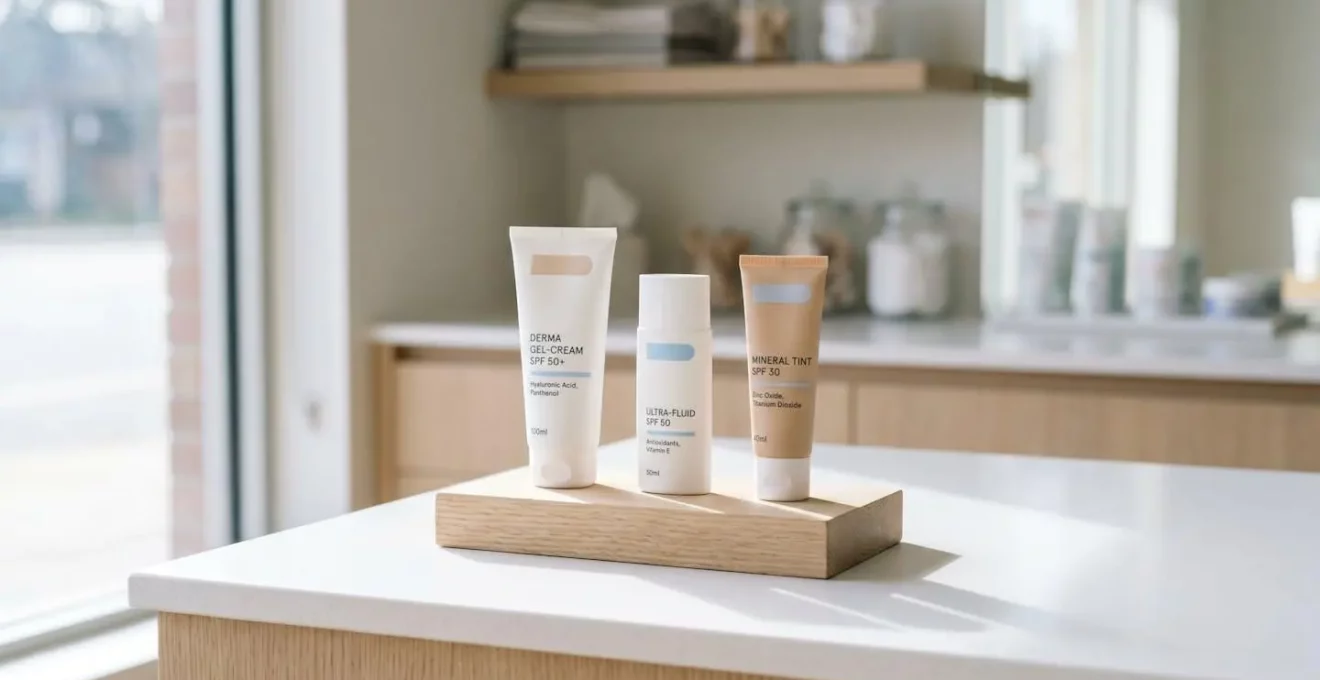
Clinical observations from dermatological practice reveal a consistent pattern. Patients describe purchasing « oil-free » formulations that nonetheless clog pores within weeks, or mineral-based products that soothe reactivity but create an unworkable white cast. The confusion stems from a gap between marketing claims and ingredient reality—a disconnect this guide addresses through formulation chemistry and regulatory standards rather than brand promotion.
The objective here is ingredient literacy. Readers should leave equipped to assess any sunscreen label independently, identify the specific filter types and texture modifiers suited to their dominant skin challenge, and avoid the comedogenic additives and fragrance compounds that perpetuate the frustration cycle.
Your 4 criteria for breakout-free sun protection
- Prioritize mineral filters (zinc oxide ≥10%) or encapsulated chemical filters for sensitive zones
- Verify comedogenic rating ≤2 on all emollients and texture modifiers
- Seek niacinamide (2-5%) or centella asiatica for dual sebum control and soothing
- Eliminate fragrance, essential oils, and fatty alcohols (cetyl, stearyl) from ingredient list
Why combination skin makes sunscreen selection uniquely challenging
The sebaceous glands across the T-zone produce lipid secretions at rates three to five times higher than cheek tissue in individuals with combination profiles. Sunscreen formulations designed to spread evenly across uniform skin types encounter immediate problems when confronted with this sebum gradient. Heavy emollients intended to prevent transepidermal water loss on dry zones create occlusive films that trap sebum in already congested follicles. Lightweight gels formulated for oily skin often rely on high alcohol concentrations or astringent silicones that strip the compromised barrier on sensitive areas, triggering compensatory inflammation.
Consider the common scenario where someone purchases a dermatologist-recommended mineral sunscreen only to find their forehead breaks out within ten days despite the « non-comedogenic » label. The issue frequently lies not in the zinc oxide filter itself—rated 0 on the comedogenic scale—but in the emulsifier system or texture modifiers added to improve spreadability. Ingredients like isopropyl myristate or certain plant-derived oils carry comedogenic ratings of 4 or 5, yet appear in formulations marketed for sensitive skin because they enhance the sensory experience during application.
Dermatological research increasingly points to the need for conditional formulation strategies rather than universal solutions. Guidance from the American Academy of Dermatology acknowledges this heterogeneity, specifying that acne-prone skin requires explicit non-comedogenic certification, while rosacea-reactive skin benefits from mineral-only filters (zinc oxide and titanium dioxide) that avoid chemical absorption pathways capable of triggering vascular inflammation.
The mineral vs. chemical filter dilemma for reactive skin
Mineral filters—zinc oxide and titanium dioxide—sit on the skin surface and reflect UV radiation. Chemical filters like avobenzone absorb UV energy and convert it to heat within the epidermis, potentially triggering histamine release in rosacea or eczema-prone skin. Dermatological consensus increasingly favours zinc oxide concentrations above 10% for reactive skin, providing broad-spectrum coverage without the absorption that provokes sensitivity flare-ups.
The trade-off surfaces in cosmetic elegance. Mineral particles historically created white cast. Formulation advances in 2025-2026 address this through micronized zinc oxide and tinted versions using non-comedogenic iron oxides.
Texture engineering: lightweight protection without oil saturation
The vehicle base determines whether a sunscreen feels heavy or breathable. Gel-cream hybrids use water-based matrices with minimal oil, relying on silica microspheres or dimethicone to create smooth application. Silica microspheres absorb surface sebum without disrupting barrier function, ideal for T-zone application. Fluid formulations employ volatile silicones that evaporate post-application, leaving only UV filters and humectants.
Serum-textured sunscreens eliminate film-forming polymers that cause pilling during makeup application, using encapsulated filter technology in a near-weightless base.
Ingredient red flags that aggravate both concerns simultaneously
Certain ingredient categories sabotage dual-concern skin regardless of the quality of the UV filter system. Fatty alcohols—cetyl alcohol, stearyl alcohol, cetearyl alcohol—appear in formulations as emulsifiers and texture enhancers. While some individuals tolerate them, clinical dermatology literature documents comedogenic ratings between 2 and 4 for these compounds, making them problematic for acne-prone zones. Essential oils and fragrance compounds represent an even clearer hazard. Recent regulatory developments underscore this risk: EU Regulation 2023/1545, published in the Official Journal of the European Union, expanded the mandatory fragrance allergen declaration list from 24 to over 80 substances in cosmetic products. This overhaul, with a compliance deadline of 31 July 2026 for leave-on products including sunscreens, reflects mounting evidence that fragrance ingredients rank among the leading causes of contact dermatitis in skincare formulations.
Decoding comedogenic ratings: The 0-5 comedogenic scale derives from laboratory testing (historically rabbit ear models, now increasingly human patch testing) that measures pore-clogging potential. A rating of 0 indicates no observable comedone formation; 5 signals high likelihood of congestion. For oily-prone skin, dermatologists recommend limiting formulations to ingredients rated 2 or below. Individual variability exists—some people tolerate a 3-rated ingredient without issue—but the scale provides a reliable baseline for initial product selection. When examining sunscreen labels, cross-reference emollients and texture modifiers against published comedogenic databases rather than relying solely on front-of-package « non-comedogenic » claims, which lack regulatory standardization in many markets.
Matching formulations to your dominant skin challenge

« Sensitive oily skin » manifests across a spectrum of severity and trigger patterns. Someone experiencing weekly inflammatory papules and persistent blackheads faces a fundamentally different formulation challenge than someone with occasional redness and mild T-zone shine. Applying a universal recommendation to this heterogeneous group guarantees suboptimal outcomes. The decision tree below acknowledges that the relative dominance of either the acne-prone or reactivity-prone concern should dictate filter type, texture priority, and active ingredient selection.
- If frequent breakouts, clogged pores, and blackheads dominate:
Acne-dominant profiles require mattifying mineral bases with active sebum regulation. Look for zinc oxide concentrations between 10-25% paired with niacinamide at 2-5%—a 2025 analysis published in the Australasian Journal of Dermatology confirms niacinamide’s dose-dependent reduction in sebaceous lipid components, making it a validated adjunctive active for oily skin management. Silica microspheres enhance mattification without comedogenicity. Avoid chemical filters on active lesions, as the heat conversion process can worsen inflammation.
- If redness, flushing, stinging reactions, or visible capillaries dominate:
Sensitivity-dominant profiles (rosacea-type reactivity or eczema-prone areas) benefit from fragrance-free hybrid formulations or pure mineral filters combined with anti-inflammatory botanicals. Centella asiatica extract—rich in madecassoside compounds—supports barrier strengthening without increasing sebum production. Bisabolol offers additional soothing without occlusion. Lightweight fluid textures prevent the heavy feel that exacerbates discomfort, while avoiding alcohol denat. protects the compromised barrier. Dermatological consensus specifies that rosacea-reactive skin should use sunscreens containing only zinc oxide and titanium dioxide, eliminating chemical filters (avobenzone, octinoxate) that may trigger vascular inflammation through their absorption and heat-conversion mechanisms.
- If moderate oiliness and occasional irritation occur without severe acne or rosacea:
Balanced combination profiles tolerate hybrid formulations that blend mineral and chemical filters for optimized cosmetic elegance. Tinted mineral sunscreens using iron oxides eliminate white cast while maintaining the non-comedogenic advantage of zinc oxide. Gel-cream hybrids incorporating hyaluronic acid deliver hydration to sensitive zones without saturating oily areas. SPF 50 broad-spectrum coverage provides margin for imperfect application—critical for users juggling multiple skin concerns who may apply unevenly. Look for encapsulated chemical filters if pure mineral formulations feel too heavy; encapsulation technology reduces direct skin contact, lowering irritation potential while preserving UVA protection.
For acne-dominant profiles, pharmacy-grade selections such as non-comedogenic sunscreen formulations prioritize ingredients rated ≤2 on the comedogenic scale, a threshold dermatologists recommend for acne-prone individuals to minimize pore congestion risk while maintaining effective broad-spectrum protection.
Acne-prone with occasional irritation: mattifying mineral priorities
When active comedones and inflammatory lesions define the clinical picture, formulation selection must treat pore congestion as the primary threat. Zinc oxide-based sunscreens offer the dual advantage of broad-spectrum UVA/UVB blocking and inherent anti-inflammatory properties—zinc itself modulates cytokine signaling pathways involved in acne pathogenesis. The addition of niacinamide at concentrations between 2-5% addresses sebum dysregulation at the source, reducing triglyceride and fatty acid output from sebaceous glands according to controlled dermatological studies.
Rosacea or eczema with oily T-zone: soothing hydration without heaviness
Vascular reactivity and barrier dysfunction require a fundamentally different approach. Mineral-only filters eliminate the photochemical heat generation intrinsic to chemical absorption, while centella asiatica and bisabolol provide anti-inflammatory support without comedogenic risk. Fragrance elimination is non-negotiable—even « natural » essential oils contain volatile terpenes and aldehydes that rank among the most common contact allergens in dermatological patch testing.
Balanced combination requiring universal tolerance
For individuals without severe acne or chronic inflammatory conditions, the formulation goal shifts to cosmetic acceptability and consistent daily use. Clinical evidence demonstrates that the best sunscreen is the one actually applied every morning—a formulation that pills up under makeup or leaves visible residue will be abandoned regardless of its theoretical UV protection. Tinted mineral sunscreens address the white cast barrier to compliance, using iron oxides (non-comedogenic rating 0) to create a sheer coverage that doubles as a makeup primer.
Ingredient benchmarks that separate effective from problematic formulas
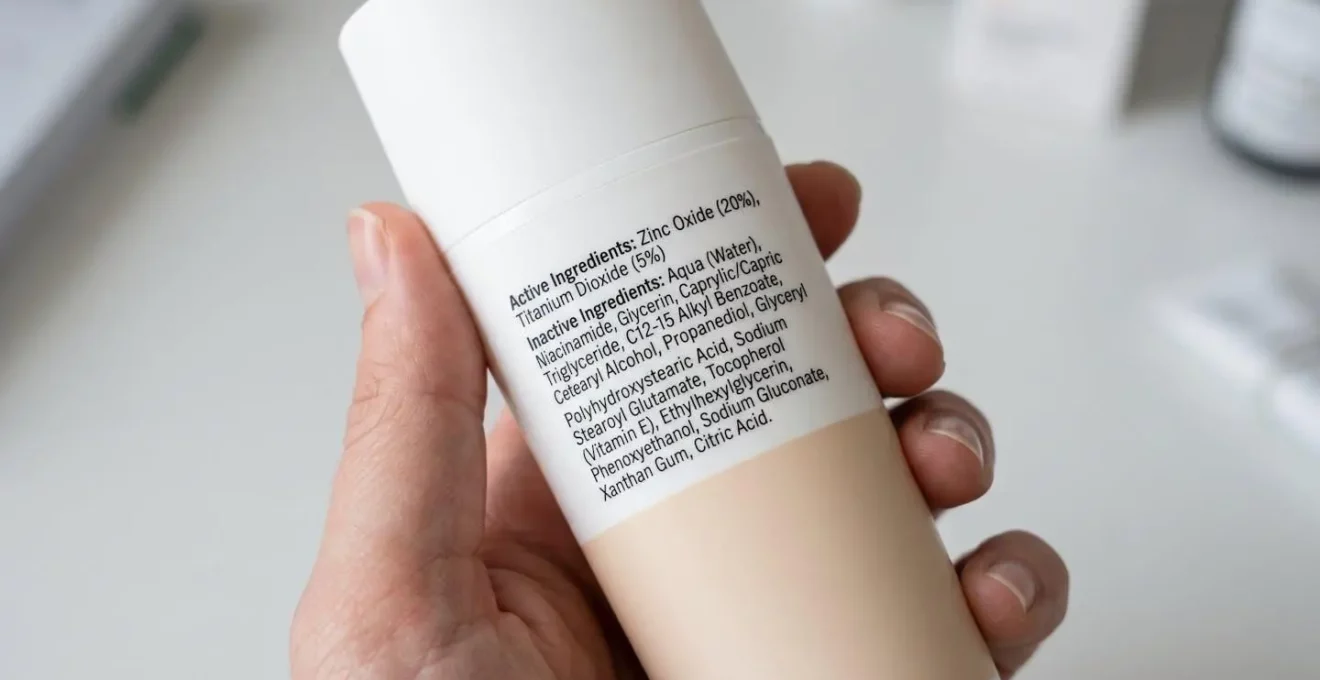
Label literacy transforms sunscreen shopping from brand roulette into informed formulation assessment. The ingredient list—presented in INCI (International Nomenclature of Cosmetic Ingredients) format on European and UK products—appears in descending concentration order. Active UV filters typically occupy the first five positions after water (aqua). What follows determines whether the product will aggravate or alleviate dual skin concerns. The table below provides a pharmacy-grade standard for evaluating these secondary ingredients.
Understanding which actives solve both problems simultaneously, and which create trade-offs, enables readers to decode any sunscreen label independently. This proves particularly valuable for individuals on prescription acne treatments—those using isotretinoin (commonly known as Accutane) face heightened photosensitivity that makes daily broad-spectrum protection medically essential rather than cosmetically optional when barrier function is compromised by systemic therapy.
| Ingredient | Impact on Oiliness | Impact on Sensitivity | Comedogenic Rating |
|---|---|---|---|
| Zinc oxide (10-25%) | Neutral to slightly mattifying | Highly soothing, anti-inflammatory | 0 |
| Niacinamide (2-5%) | Regulates sebum production | Barrier-strengthening, well-tolerated | 0 |
| Silica microspheres | Absorbs surface oil, mattifying | Non-irritating at ≤5% | 0 |
| Centella asiatica extract | Neutral | Anti-inflammatory, calming | 0 |
| Fragrance / Essential oils | Neutral | Leading cause contact dermatitis | Variable (avoid) |
The maximum acceptable comedogenic rating for acne-prone skin remains a subject of clinical debate, but dermatological practice converges on ≤2 as the threshold for minimizing breakout risk. Ingredients rated 3 or above appear frequently in mass-market formulations because they enhance spreadability or extend shelf stability, but their inclusion represents a calculated trade-off that prioritizes manufacturing convenience over skin tolerance. Pharmacy-curated selections screen for this criterion during formulation vetting, ensuring that texture modifiers and preservatives remain within the non-comedogenic boundary.
Fragrance deserves particular scrutiny. The 2023 EU regulatory expansion to over 80 declared allergens reflects accumulating evidence that even « dermatologically tested » fragrances provoke type IV hypersensitivity reactions in a substantial subset of sensitive-skin individuals. When a label lists « parfum » or « fragrance » without further specification, it may contain any combination of dozens of undisclosed volatile compounds—an unacceptable opacity for anyone managing reactive skin.
Application strategies that prevent midday shine and irritation flare-ups
Formulation quality becomes irrelevant if application technique undermines the product’s protective capacity or triggers the cosmetic failures—pilling, greasiness, white streaks—that lead to abandonment. The gap between laboratory efficacy and real-world performance often narrows to execution rather than chemistry. A sunscreen that works impeccably on bare skin may pill up when layered over serums, or a mineral formula that appears sheer when applied to one facial zone may leave visible residue on another due to sebum density differences.
Zone-adapted application acknowledges that combination skin requires differential product distribution. Applying uniform thickness across all facial areas results in excess buildup on the T-zone or insufficient coverage on dry cheeks. The protocol below optimizes for both protection and cosmetic acceptability, addressing the practical realities of morning skincare routines and midday reapplication over makeup.
- Apply serum or moisturizer, wait 60-90 seconds, then dispense 1/4 teaspoon sunscreen
Layering sunscreen onto still-wet skincare creates emulsion instability, causing pilling. Allowing humectants to penetrate fully prevents this interaction. The standard 2mg/cm² application used in SPF testing translates to roughly 1/4 teaspoon for face and neck. Allocate two-thirds to cheeks and forehead, one-third to the oily T-zone to maintain adequate protection while avoiding saturation that triggers midday shine.
- Pat gently into skin rather than rubbing aggressively
Vigorous rubbing generates friction heat and mechanical stress that can provoke inflammation in sensitive areas, particularly around the nose and under-eye zones where the stratum corneum is thinner. Patting motions allow mineral particles to settle evenly without displacing product or irritating reactive tissue. This technique also reduces white cast visibility by pressing particles into skin texture rather than leaving them on the surface.
- Wait 10-15 minutes before makeup application to allow sunscreen film formation
UV filters require time to bond with the stratum corneum and form a continuous protective film. Applying foundation or powder immediately after sunscreen disrupts this process, creating gaps in coverage and increasing pilling risk. The wait period also allows volatile silicones to evaporate, leaving a drier base for makeup adhesion.
- For midday reapplication over makeup: use powder SPF on T-zone, liquid or stick formula on cheeks
Dermatological guidelines recommend reapplication every 2 hours during continuous sun exposure, but applying cream sunscreen over a full face of makeup proves impractical for most users. Powder formulas with mineral filters allow T-zone touch-ups without disturbing foundation, while liquid or stick formulations can be gently patted onto cheek and temple areas. This hybrid approach maintains protection on high-exposure zones without requiring complete makeup removal. For indoor office environments with incidental sun exposure, a single morning application with powder touch-up at midday often suffices.
- Evening double-cleanse with oil-based cleanser first, then gentle foaming wash
Mineral filters create water-resistant films that single-step cleansing often fails to remove completely, leaving residual zinc oxide or titanium dioxide particles that can migrate into pores overnight. An oil-based first cleanse dissolves the sunscreen matrix through emulsification, while the subsequent foaming wash removes any remaining surfactants without stripping the barrier. This two-step process prevents the paradox of using non-comedogenic sunscreen by day yet experiencing breakouts from inadequate removal at night.
Application consistency matters more than product perfection. A well-formulated sunscreen applied sporadically or in insufficient quantity provides less protection than a moderately elegant formula used correctly every day. The techniques above reduce the friction points—cosmetic inconvenience, sensory unpleasantness, time pressure—that erode adherence, making daily broad-spectrum protection sustainable rather than aspirational.
Questions frequently raised about sunscreen tolerance and efficacy
Technical uncertainties and conflicting online advice create hesitation that delays adoption of effective sun protection. The questions below address the most common points of confusion encountered in dermatological consultations and skincare forums, providing evidence-based clarity on tinted formulations, SPF ratings, medication interactions, product stability, and vitamin D synthesis concerns.
Does tinted sunscreen eliminate white cast without increasing breakout risk?
Tinted mineral sunscreens use iron oxides—inorganic pigments with a comedogenic rating of 0—to neutralize the white appearance of zinc oxide and titanium dioxide particles. The pigment load typically ranges between 1-3% by weight, insufficient to clog pores in individuals without pre-existing sensitivity to iron compounds. The tint serves a dual function: cosmetic acceptability and additional visible light protection, as iron oxides absorb wavelengths in the 400-500nm range that contribute to hyperpigmentation in darker skin tones. When selecting tinted formulations, verify that the base ingredients (emulsifiers, texture modifiers) also meet non-comedogenic standards, as the iron oxide addition addresses only the white cast issue, not the broader formulation quality.
Is SPF 50+ necessary for daily indoor work, or is SPF 30 sufficient?
For office environments with incidental sun exposure—commute, window proximity, lunch breaks—SPF 30 provides adequate protection if applied at the correct density (2mg/cm² or approximately 1/4 teaspoon for face and neck). SPF 50+ blocks roughly 98% of UVB radiation versus 97% for SPF 30, a marginal 1% absolute difference. The higher rating offers reassurance if application tends to be uneven or below the recommended quantity, effectively providing a safety margin for real-world usage imperfection. Window glass blocks most UVB but allows UVA penetration, so broad-spectrum coverage (indicated by UVA logo or « UVA » in circle on European products) matters more than the SPF number for indoor workers. Both SPF 30 and SPF 50+ require reapplication every 2 hours during continuous outdoor exposure to maintain labeled protection.
Can I use the same sunscreen if I’m taking prescription retinoids or acids?
Prescription retinoids (tretinoin, adapalene, tazarotene) and chemical exfoliants (glycolic acid, salicylic acid at prescription strength) increase photosensitivity by accelerating epidermal cell turnover and thinning the stratum corneum. This makes daily broad-spectrum SPF 30 minimum non-negotiable rather than optional. Mineral-based sunscreens prove preferable during retinoid therapy, as they avoid the potential irritation from chemical filter absorption on already sensitized skin. Apply sunscreen as the final morning skincare step, ensuring the retinoid (used exclusively in evening routines due to photodegradation) has fully absorbed from the prior night. If using chemical exfoliants in the morning, allow 5-10 minutes before sunscreen application to prevent pH-driven interactions that could compromise filter stability.
How long does sunscreen remain effective after opening the bottle?
Most sunscreens maintain UV filter stability and preservative efficacy for 12 months after opening when stored properly—cool, dry location away from direct heat or sunlight. Check the PAO (Period After Opening) symbol on the packaging, typically displaying « 12M » inside an open jar icon. Chemical filters like avobenzone and octocrylene degrade faster than mineral filters when exposed to UV light and elevated temperatures, so sunscreens left in car glove boxes or beach bags may lose efficacy before the 12-month window. Discard the product if you notice odor changes (rancid smell indicating lipid oxidation), texture separation that doesn’t remix when shaken, color changes, or if the product exceeds the printed expiration date. Using degraded sunscreen provides false security—the texture may feel normal, but UV protection has diminished below the labeled SPF.
Will mineral sunscreen prevent my skin from producing vitamin D?
Both mineral and chemical sunscreens reduce UVB exposure, which is required for cutaneous vitamin D3 synthesis (7-dehydrocholesterol conversion to pre-vitamin D3). Dermatologists prioritize skin cancer prevention and photoaging reduction over UV-dependent vitamin D production, recommending dietary sources (fatty fish, fortified dairy, egg yolks) or supplements (typically 1000-2000 IU daily for adults, adjusted based on blood levels) rather than unprotected sun exposure. Brief incidental exposure—10-15 minutes on arms and legs without sunscreen—may suffice for lighter skin tones in summer months, but this approach carries cumulative DNA damage risk. Facial sun protection should remain consistent regardless of vitamin D strategy, as the face represents high-risk anatomical territory for skin cancer and receives disproportionate UV exposure.
Your immediate action steps for breakout-free UV protection
- Audit your current sunscreen’s ingredient list against the comedogenic table in section 3—if emollients rated ≥3 appear in the first ten ingredients, replacement is warranted
- Identify your dominant challenge using the decision tree in section 2, then prioritize filter type and actives accordingly—acne-dominant toward mattifying minerals, sensitivity-dominant toward fragrance-free soothing formulations
- Implement zone-adapted application: two-thirds of product volume on cheeks and forehead, one-third on T-zone, with 60-90 second wait time after prior skincare layers
- Verify broad-spectrum compliance and check PAO dating on existing products—degraded filters provide false security without actual UV protection
- Individual skin reactivity varies significantly; patch testing is recommended before full facial application.
- This guide provides general criteria and should not replace personalized advice from a dermatologist familiar with your medical history.
- Product formulations may change; always verify current ingredient lists and regulatory approvals.
- Severe or persistent skin reactions require professional medical evaluation.
Consult a board-certified dermatologist for chronic skin conditions, suspected allergies, or if uncertainty persists after trying recommended formulations.